

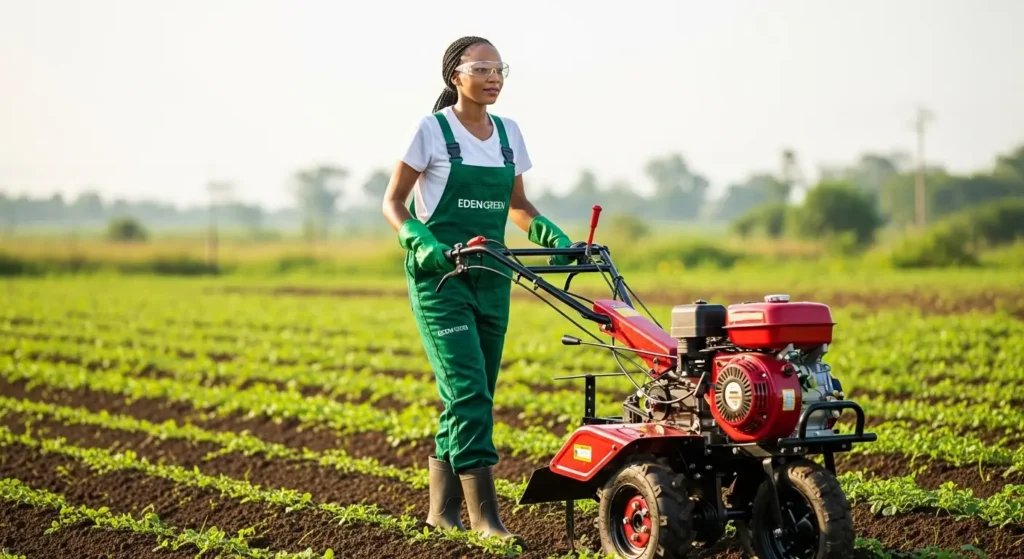
Africa’s capacity to feed itself over the coming decades will be determined not by large estates or industrial-scale farming alone, but by the productivity, resilience and economic viability of millions of smallholder farmers across the continent. These farmers cultivate the majority of food consumed locally, yet continue to operate under low levels of mechanization, high labor burdens and increasing climate risk.
Farm mechanization when strategically designed and systemically embedded represents one of the most underleveraged pathways for delivering scalable, inclusive and climate-aligned impact.
However, this impact will not be realized through traditional, large-scale mechanization models alone.
Africa’s future of food security will be written on small plots – fragmented holdings averaging a few acres where families produce most of the continent’s food – Wesly Museve (The Gardener)
Mechanization, therefore, is not a peripheral investment. It is a structural requirement for delivering food security, building climate resilience and creating dignified rural livelihoods particularly for youth and women. When appropriately designed, farm mechanization reduces drudgery, improves timeliness of operations, lowers post-harvest losses and increases system-wide efficiency across production, aggregation and processing.
From my professional experience across NGO-led agricultural programs, youth-focused climate initiatives and private-sector machinery engagement in Kenya, one lesson is clear: mechanization succeeds when it is smallholder-first, systems-driven and embedded within local service, finance and skills ecosystems. Where it is treated merely as equipment delivery, impact remains limited and unsustainable.
Across Kenya and much of Africa, a quiet but meaningful shift is underway. Policymakers, development partners and private actors are beginning to reframe mechanization away from tractor ownership toward access-based service models, appropriate-scale machinery and youth-led enterprises. This transition aligns mechanization more closely with climate-smart agriculture, inclusive economic growth and food systems transformation agendas.
Reframing mechanization for development outcomes
For much of the past half-century, mechanization in Africa was approached as a capital-access challenge focused on importing machines rather than building systems. The result has been uneven adoption, low utilization rates and limited sustainability beyond project lifecycles.
A more effective approach centers on appropriate-scale mechanization, defined by:
- Compatibility with small and fragmented landholdings
- Integration within mixed cropping and rain-fed systems
- Alignment with labour dynamics, particularly for women and youth
- Capacity for local maintenance, adaptation, and enterprise development
From power tillers and seeders to multi-crop threshers, chippers, and irrigation pumps, these technologies generate measurable development outcomes when paired with training, service delivery frameworks, and market access.
Mechanization, in this context, functions as a means to institutional efficiency, not an end product.
Kenya and Africa: emerging momentum with strategic lessons
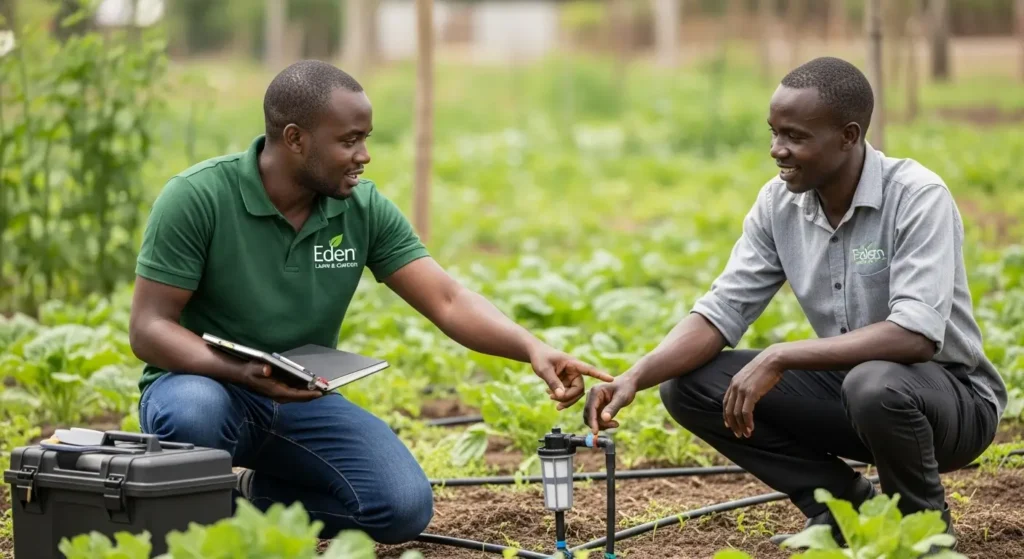
Kenya provides a useful case study for mechanization-for-development at sub-national scale. Counties increasingly integrate mechanization into Food & Nutrition Security, Climate Action Plans and Youth Employment Strategies.
Several continent-wide trends are becoming evident:
- Decentralized mechanization models, driven by county governments and community-based organizations
- Growth of youth-led mechanization service enterprises, shifting youth from beneficiaries to economic actors
- Donor-supported pilots embedding mechanization into CSA and resilience programs
- Private-sector engagement in equipment supply, training, and after-sales support
Through my work with SMACHS Foundation, a youth-led climate-smart agriculture organization, I supported the design and implementation of programs that deliberately embedded mechanization within youth empowerment, climate adaptation and systems-change frameworks. As Project and Partnerships Lead, I worked on initiatives that linked hardware deployment with capacity building, behaviour change and enterprise models, ensuring mechanization generated durable outcomes beyond pilot phases.
Persistent system constraints limiting scale
Despite momentum, mechanization initiatives across Africa continue to face recurring constraints that undermine impact and return on investment.
1. Asset-centric program design
A disproportionate share of funding is allocated to equipment procurement, with limited parallel investment in:
- Operator and technician training
- Utilization and service-delivery models
- O&M planning and spare-parts ecosystems
- Monitoring, evaluation, and learning (MEL) frameworks
Without these, machines remain underutilized or fail prematurely.
2. Financing misalignment
Most smallholders do not require ownership of machinery; they require timely and reliable access. Yet financing instruments still prioritize asset acquisition rather than revenue-backed service provision, limiting outreach and scalability.
3. Fragmented institutional coordination
Mechanization sits at the intersection of agriculture, trade, youth and climate policy. Weak inter-institutional alignment results in duplication, policy inertia, and inconsistent incentives across public and private actors.
From a resource-mobilization and implementation perspective, mechanization succeeds only when these systems are addressed holistically.
The role of partnerships and market-based delivery
Development impact at scale requires private-sector participation that is both commercially viable and development-aligned. My engagement with Eden Lawn & Garden Centre reflects this hybrid approach—bridging equipment supply, technical advisory, and last-mile engagement with farmers and institutions.
Effective public-private-development partnerships (PPDPs) in mechanization can:
- Improve equipment relevance and uptake
- Strengthen service and maintenance ecosystems
- Reduce total cost of ownership or access
- Enable data feedback for adaptive programming
When structured correctly, market-based delivery reduces donor dependency while accelerating adoption and localization.
Youth, climate action and mechanization as a livelihood pathway
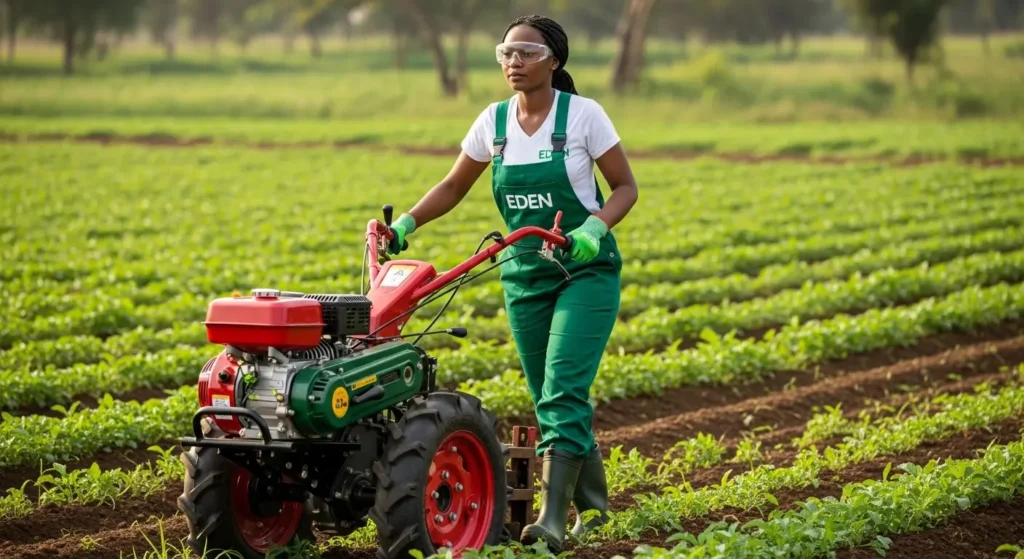
Africa’s youth bulge presents both a risk and an opportunity. Mechanization is uniquely positioned at this nexus-capable of delivering productive employment while advancing climate adaptation goals.
Machines that support:
- Conservation agriculture and reduced tillage
- Energy- and water-efficient systems
- Post-harvest loss reduction
also support climate mitigation and resilience outcomes. When youth are trained as operators, technicians, and service providers, mechanization shifts from a cost center to a livelihood engine.
Across grant-funded pilots and program implementation, I have observed how mechanization reframes agriculture from an employment of last resort to a technologically enabled enterprise.
Strategic recommendations for donors and implementing partners
Based on field experience, program design, and partnerships work, the following priorities should guide future investment:
- Fund access-based mechanization models over ownership-focused interventions
- Integrate mechanization into youth employment, CSA, and market systems programs
- Allocate dedicated budgets for training, maintenance, and ecosystem development
- Embed MEL frameworks to track utilization, cost savings, productivity gains, and resilience indicators
- Incentivize public–private partnerships that align commercial sustainability with development outcomes
These shifts increase cost-effectiveness, scalability, and sustainability of donor investments.
Conclusion: mechanization as development infrastructure
Farm mechanization should be treated as development infrastructure, not discrete equipment. When embedded within systems skills, finance, policy, markets it delivers compounding returns across food security, climate resilience, and employment.
Kenya and Africa have made important progress. The next phase requires deeper systems thinking, stronger coordination, and practitioner voices grounded equally in policy, field implementation, and market realities.
This is the contribution I seek to make: advancing evidence-based, partnership-driven mechanization strategies that ensure smallholder farmers cultivating only a few acres remain central to Africa’s food future.
Author Profile
Wesly Museve is an agricultural mechanization practitioner and partnerships specialist with over ten years of experience working across NGOs, private-sector agribusiness and donor-supported programs in Kenya. He holds a Bachelor of Science in Agriculture from the University of Nairobi and has contributed to grant-winning proposals, climate-smart agriculture initiatives, youth employment programs and mechanization systems design. He has held senior roles at SMACHS Foundation and currently serves as Business Development Lead and Brand Ambassador at Eden Lawn & Garden Centre. Wesly works at the intersection of policy, partnerships and practical implementation.




0 Responses
I think this is among the most vital information for me. And i am glad reading your article. But want to remark on some general things, The site style is wonderful, the articles is really excellent : D. Good job, cheers